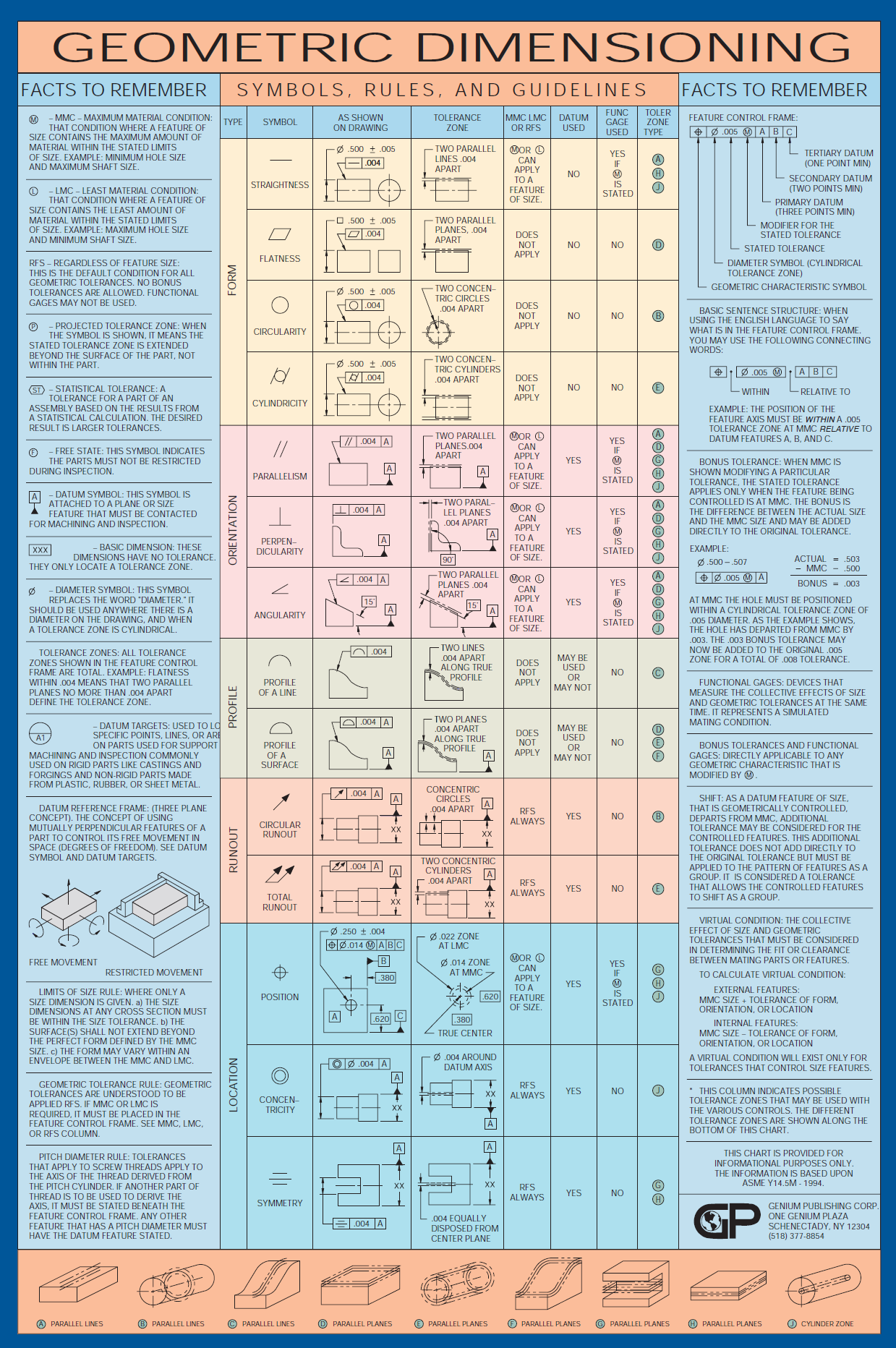
What You’ll Learn & Inside the Guide
✅ Core GD&T Definitions: Clear explanations of MMC (Maximum Material Condition), LMC (Least Material Condition), and RFS (Regardless of Feature Size)—the foundation of geometric tolerancing, with real-world examples for holes and shafts.
✅ Tolerance Zone Breakdowns: Detailed specs for every geometric control (Form, Orientation, Profile, Runout, Location) including straightness, flatness, parallelism, position, concentricity and more, with exact tolerance zone dimensions and application rules.
✅ Datum & Reference Frame Rules: Master datum symbols, datum targets, the three-plane datum reference frame, and how to restrict part degrees of freedom for machining/inspection.
✅ Critical GD&T Rules: Limits of Size, Geometric Tolerance, and Pitch Diameter rules, with step-by-step guidance for screw thread axis derivation and tolerance application.
✅ Practical GD&T Calculations: Bonus tolerance, virtual condition (for internal/external features), shift tolerance, and how to calculate combined size/geometric tolerance effects for mating parts.
✅ Functional Gages & Inspection: Learn how functional gages work to measure size/geometric tolerances simultaneously, and free state inspection requirements for flexible parts (plastic, rubber, sheet metal).
✅ GD&T Best Practices: Facts to remember (primary/secondary/tertiary datum points), feature control frame sentence structure, and statistical tolerance for assembly design.
Key Features of This Guide
📄 Concise, Organized Format: Tabular breakdowns of geometric controls, tolerance zones, MMC/LMC/RFS applicability, and datum usage for quick reference.
🔍 Real-World Examples: Every core concept is paired with practical examples (e.g., hole/shaft MMC/LMC, bonus tolerance calculations) to bridge theory and application.
⚙️ Manufacturing-Focused: Tailored for industrial use—relevant for machining, casting, forging, and plastic/rubber part production and inspection.
📐 Precision Details: Exact tolerance zone dimensions (0.004” standard) and geometric control specs to align with industry drawing standards.
Who This Guide Is For
- Design & manufacturing engineers creating technical drawings
- Machinists and CNC operators executing precision part production
- Quality control inspectors verifying geometric tolerances
- Engineering students learning GD&T fundamentals
- Production supervisors overseeing precision manufacturing processes